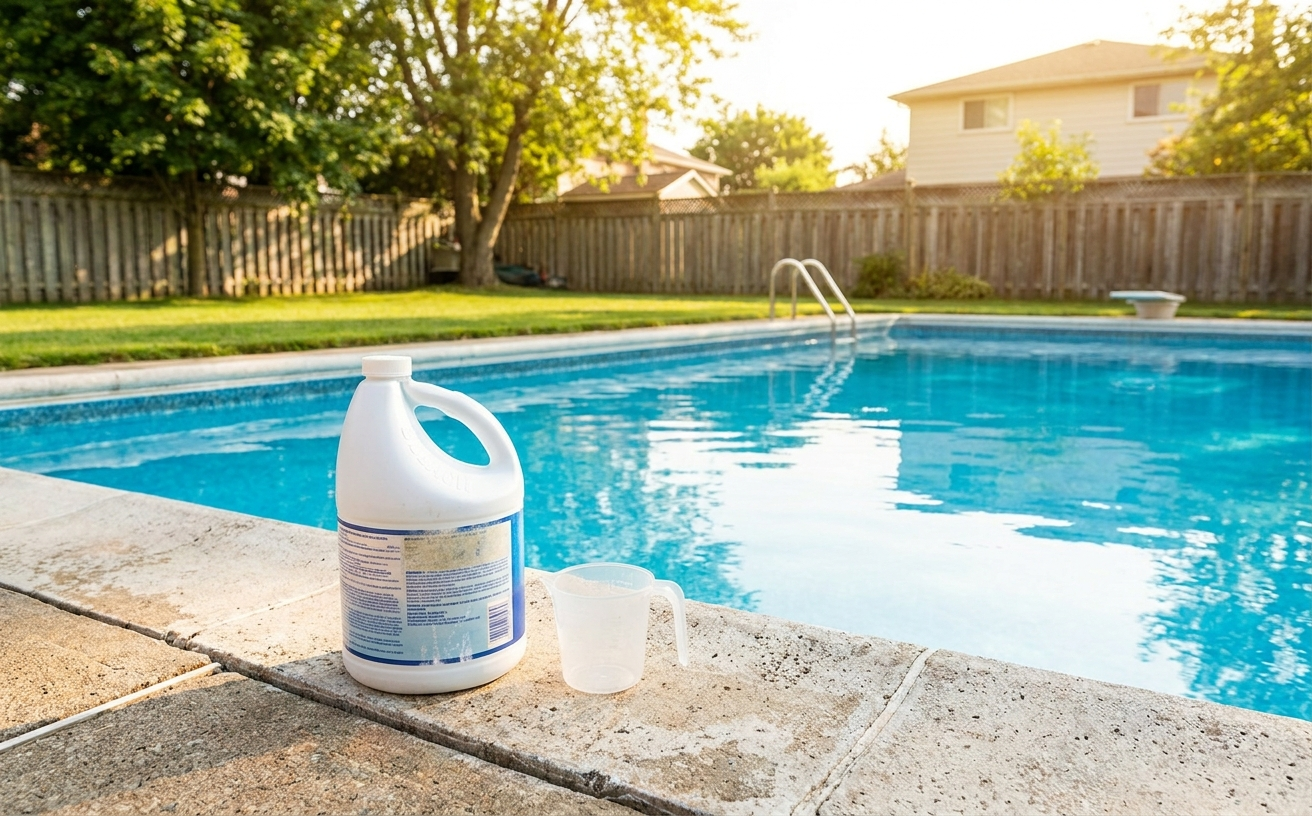
It seems like a smart move. You ran out of pool chlorine, but there is a bottle of bleach under the kitchen sink. Same active ingredient, right? Just pour some in and save yourself a trip to the store.
Plenty of pool owners have tried this. Some get away with it once or twice. But using household bleach as a regular chlorine source is a shortcut that comes with real consequences, and most of them do not show up until it is too late.
The difference between pool chlorine and household bleach goes well beyond the label on the bottle. Understanding those differences is the key to protecting your water, your equipment, and your wallet.
What Household Bleach Actually Contains
Standard household bleach is a solution of sodium hypochlorite, typically between five and six percent concentration. That is the same active compound found in liquid pool chlorine. So far, so good.
But household bleach often contains additional ingredients that have no business in a swimming pool. Fragrances, thickeners, and surfactants are added to improve cleaning performance on laundry and household surfaces. These additives can cause foaming, leave residues, and interfere with water chemistry.
Even unscented varieties may still contain stabilizers that prevent the bleach from breaking down on the shelf. These stabilizers are not designed for pool use and can accumulate in the water over time.
The Concentration Problem
Pool-grade liquid chlorine is typically sold at ten to twelve percent sodium hypochlorite, roughly double the strength of household bleach. This means you need about twice as much bleach to achieve the same chlorine level in your pool.
That extra volume matters. More liquid means more water, more sodium, and more of whatever additives the bleach contains. Over the course of a summer, the cumulative effect is significant.
What Bleach Does to Your Water Over Time
Every dose of sodium hypochlorite, whether from pool chlorine or household bleach, adds salt to your water as a byproduct of the chemical reaction. Because bleach is roughly half the strength of pool chlorine, you are adding about twice the liquid volume each time, which means salt accumulates faster.
High salt levels can affect water balance and may interfere with the performance of some test kits. In extreme cases, you may need to partially drain and refill the pool to bring salt levels back down.
- Faster salt accumulation from double-dose applications
- Additive residues that create surface film or foaming
- Inconsistent chlorine delivery due to varying bleach concentrations
- Potential pH spikes from the alkaline nature of bleach
For anyone considering this approach for routine maintenance, a proper pool bleach guide covers safe dosing, what to watch for, and when to switch to pool-grade products instead.
When Bleach Is an Acceptable Emergency Option
In a genuine emergency, plain unscented bleach with no additives can serve as a temporary chlorine source. If you cannot get pool chlorine for a day or two and your levels have dropped to zero, a small dose of bleach can prevent algae from gaining a foothold.
The key word is temporary. Use the minimum amount needed to establish a one to two ppm free chlorine reading. Test after adding, and switch back to pool-grade chlorine as soon as it is available.
- Use only plain unscented bleach with no additives or fragrances
- Calculate dose based on five percent sodium hypochlorite concentration
- Pour slowly into the deep end with the pump running
- Test after thirty minutes and adjust if needed
- Return to pool-grade chlorine at the next opportunity
Why Pool Chlorine Is Worth the Trip
Pool-grade liquid chlorine is formulated specifically for swimming pool use. It is more concentrated, free of unnecessary additives, and manufactured to consistent quality standards. The higher concentration means you add less volume, which means less salt, less sodium, and less impact on your overall water balance.
Granular shock products offer even more concentrated dosing and are available in formulations designed for different water conditions. Trichlor tablets provide slow, steady chlorine delivery that reduces daily maintenance effort.
The price difference between bleach and pool chlorine is smaller than most people think. When you factor in the doubled dosage and the potential costs of correcting water balance issues caused by bleach additives, pool-grade products are often cheaper in the long run.
Protecting Your Investment
A swimming pool is a significant investment in your home and your lifestyle. The chemicals you choose to maintain it directly affect how long that investment lasts and how much you enjoy it.
Using the right products, in the right amounts, at the right intervals, is not about spending more money. It is about spending wisely. Pool chemistry is a system, and every input affects every other element of that system.
If you have been relying on household bleach for a while and notice your water balance is increasingly hard to manage, the bleach may be part of the problem. Switching to proper pool chemicals and doing a full water test can reveal imbalances that have been building up unnoticed.
Save the household bleach for the laundry room. Give your pool the chemicals it was designed to work with, and it will return the favor with clear, comfortable water all season long.